
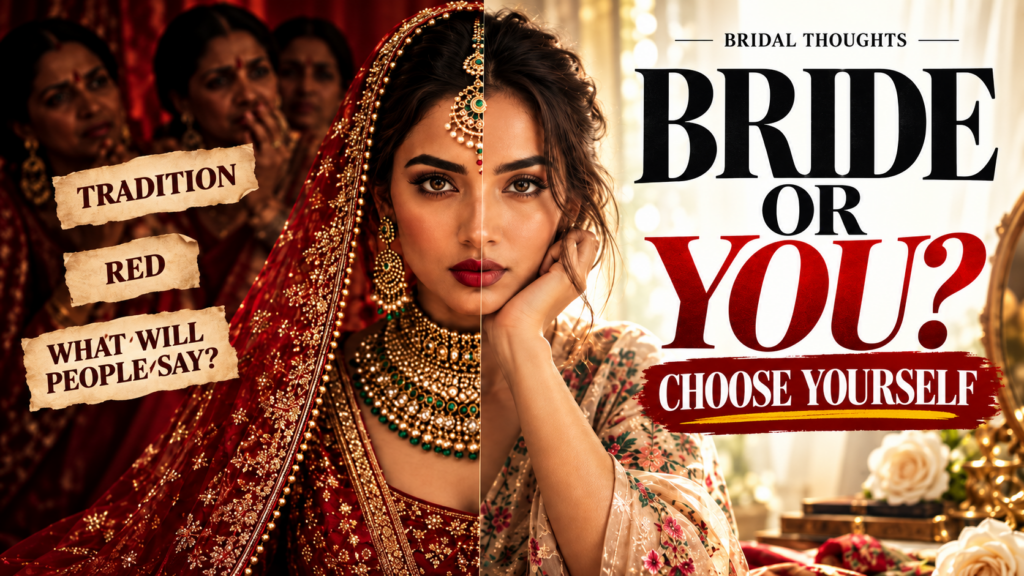
There is a picture of a bride in your head.
You probably didn’t put it there.
You inherited it.
Red.
Gold.
Embroidery.
Jewellery.
A certain silhouette.
A certain amount of grandeur.
A certain idea of what looking “bridal” means.
And then, one day, you become the bride.
Suddenly the picture becomes a prescription.
Everyone has suggestions.
Your mother.
Your aunt.
Your friends.
The designer.
Instagram.
Tradition.
“Brides usually wear…”
“You should definitely…”
“This will look more bridal…”
“This is what everyone is doing now…”
And before you realise it, the question becomes:
How should I look like a bride?
Perhaps that’s the wrong question.
Perhaps the better one is:
How should I look like me?
The most personal thing you wear shouldn’t feel impersonal
You will probably never spend as much time thinking about another outfit.
Months of searching.
Trying.
Saving photographs.
Discussing colours.
Choosing jewellery.
Adjusting sleeves.
Changing embroidery.
Thinking about every detail.
And yet, strangely, bridal fashion often begins with what thousands of other brides have already worn.
What if it began somewhere else?
With you.
Not a trend.
Not a Pinterest board.
Not a celebrity wedding.
You.
What you love.
What you remember.
What makes you feel beautiful.
What makes you feel comfortable.
What makes you feel powerful.
What makes you feel like yourself.
Because the goal shouldn’t simply be to create a beautiful bridal outfit.
There are many beautiful bridal outfits.
The goal could be to create one that could only belong to you.
Your personality can be embroidered
We tend to think of embroidery as decoration.
Flowers.
Paisleys.
Peacocks.
Vines.
Geometric borders.
Beautiful things chosen because they look beautiful.
But embroidery can do something more interesting.
It can remember.
Maybe jasmine reminds you of your grandmother.
Use jasmine.
Maybe you grew up near the sea.
Perhaps there is water hidden somewhere in the pattern.
Maybe you love birds.
Architecture.
Books.
Mountains.
Stars.
A particular flower.
A city.
A place where the two of you met.
A symbol nobody else would understand.
Put it there.
It doesn’t need to announce itself.
In fact, perhaps the most meaningful detail on your outfit is one almost nobody notices.
Because they only need to see embroidery.
You need to see the story.
That changes the garment.
It isn’t simply decorated anymore.
It belongs to you.
Colour isn’t a rule
Consider red.
For generations of Indian brides, red has carried extraordinary meaning.
Love.
Prosperity.
Celebration.
Marriage.
History.
Perhaps you adore it.
Then wear the deepest, richest red you can find.
Not because brides wear red.
Because you love red.
That’s an important distinction.
And if you don’t love red?
Then don’t let symbolism become obligation.
Maybe you feel most alive in yellow.
Maybe you’ve always worn blue.
Maybe deep green feels like you.
Maybe it’s ivory.
Pink.
Orange.
Wine.
Black.
Perhaps there are ten colours.
The question isn’t whether the colour is traditional enough.
Or modern enough.
Or different enough.
The question is simpler.
Did you choose it?
Individuality doesn’t always look unconventional
This matters.
Because personal expression has developed its own uniform too.
The unconventional bride.
The pastel bride.
The minimal bride.
The bride who “breaks the rules.”
But choosing differently simply for the sake of being different is still allowing the rules to make the decision.
Just in reverse.
A woman wearing a traditional red or maroon bridal lehenga because she deeply loves everything it represents may be expressing herself just as authentically as the woman who chooses an ivory sari.
One isn’t braver.
One isn’t more modern.
One isn’t more Ritih.
Choice is the point.
Not rebellion.
Your fabric has a personality too
Some women want structure.
Some want softness.
Some want weight.
Some want movement.
Some want silk that announces its presence when they enter the room.
Others want something so light they almost forget they’re wearing it.
Neither is right.
But one might be right for you.
Because clothes communicate before embroidery ever begins.
A structured textile feels different from something fluid.
Velvet says something different from organza.
Silk moves differently from chiffon.
Even weight changes the way you inhabit an outfit.
And your wedding day is a day you actually have to inhabit.
You will walk.
Sit.
Stand.
Hug.
Cry.
Laugh.
Eat.
Dance.
Be photographed from angles you didn’t know existed.
And, somewhere amongst all of that, get married.
The outfit needs to live with you.
Not simply photograph well on you.
Tradition is not the problem
This is where the conversation often becomes too simple.
Traditional.
Modern.
Pick one.
But culture doesn’t work that way.
Neither do people.
You can love your grandmother’s jewellery and want a completely contemporary blouse.
You can wear a traditional red lehenga with embroidery nobody has seen before.
You can borrow a motif from an old family textile and change its colour.
You can preserve the craft and change the composition.
You can keep almost everything.
Or almost nothing.
The interesting question isn’t:
Traditional or modern?
It is:
What deserves to come with me?
That is a much more personal question.
And perhaps a much more respectful one too.
Because tradition becomes meaningful when we engage with it.
Not simply when we repeat it.
This is where Ritih begins
Ritih comes from a simple belief.
Tradition belongs to you.
Not to a rulebook.
Not to an algorithm.
Not to a designer.
Not even entirely to the generation before you.
Tradition reaches you carrying stories, craft, rituals, memories and meaning.
But when it reaches you, something important happens.
You become part of the story.
You decide what continues.
You decide what changes.
You decide what becomes yours.
Ritih isn’t interested in telling a bride to abandon tradition.
And it isn’t interested in telling her to obey it.
We’re interested in something much more powerful.
Ownership.
Imagine starting differently
Most bridal conversations begin like this:
“What colour bridal Lengha are you looking for?”
“What style do you like?”
“Do you want heavy or light embroidery?”
Useful questions.
But perhaps they’re not the first questions.
Perhaps we should begin here:
What are you like?
What do you love?
What do you want to remember?
What part of your family do you want with you?
What makes you feel beautiful?
What colours have always belonged to you?
What would make you smile if it were secretly embroidered somewhere?
What do you want to carry forward?
What are you ready to leave behind?
And then—
let’s design the outfit.
Imagine how different bridalwear might become if we started there.
A lehenga can be beautiful without saying anything
Many are.
The embroidery can be extraordinary.
The craftsmanship impeccable.
The colour stunning.
But beauty and meaning aren’t the same thing.
Meaning requires a relationship.
Why this motif?
Why this colour?
Why this fabric?
Why this craft?
Why this detail?
When there is an answer, something changes.
You no longer simply own the garment.
You recognise yourself in it.
And perhaps that’s a more interesting definition of luxury.
Not how many hours it took.
Not how much embroidery covers it.
Not how much it cost.
But how impossible it would be for the garment to belong to anyone else.
One day, the wedding photograph becomes an old photograph
This is easy to forget.
Right now you’re thinking about your wedding.
One day you’ll be remembering it.
The photographs will age.
The trends will change.
The bridal colour everyone wanted that year will become associated with that year.
The silhouettes will change.
The blouse shapes will change.
Something that feels incredibly fashionable today will eventually tell people exactly when you got married.
That’s fine.
Fashion is allowed to be fashion.
But there is something that ages differently.
Personality.
Memory.
Meaning.
You may forget which bridal trend was popular.
You probably won’t forget why your grandmother’s flower was embroidered into your dupatta.
You won’t forget why you chose that particular shade.
You won’t forget the little symbol hidden near the hem.
And twenty years later, perhaps your daughter—or your niece, or someone you love—will ask:
“Why is this here?”
And suddenly an outfit becomes a story again.
You don’t need to look less like a bride
You need to look more like yourself.
That’s the distinction.
We’re not asking you to reject the red.
We’re asking whether you love the red.
We’re not asking you to abandon embroidery.
We’re asking what you would like it to say.
We’re not asking you to ignore tradition.
We’re asking which traditions feel meaningful enough to carry.
We’re not asking you to be different.
We’re asking you to choose.
Because there are already enough people telling women what a bride should look like.
Perhaps bridal design can do something better.
It can ask:
Who are you?
And listen carefully to the answer.
The mirror test
At some point, after months of decisions, there will be a moment when you’re finally dressed.
The lehenga.
The jewellery.
The hair.
The makeup.
Everything.
You’ll look in the mirror.
And of course, you want to feel beautiful.
But perhaps there is another feeling worth looking for.
Recognition.
Not:
“I finally look like a bride.”
But:
“There I am.”
That’s the bridal outfit we’re interested in creating.
Not simply something everyone remembers.
Something you recognise.
Something where colour, craft, fabric, memory and personality have quietly found their way into the same garment.
Something traditional, perhaps.
Something unconventional, perhaps.
Something in between.
It doesn’t really matter.
As long as when you look at it, you know why every choice belongs there.
Because your bridal outfit doesn’t need to represent everyone’s idea of an Indian bride.
It can represent one particular woman.
You.
That is Ritih.
Tradition belongs to you.