
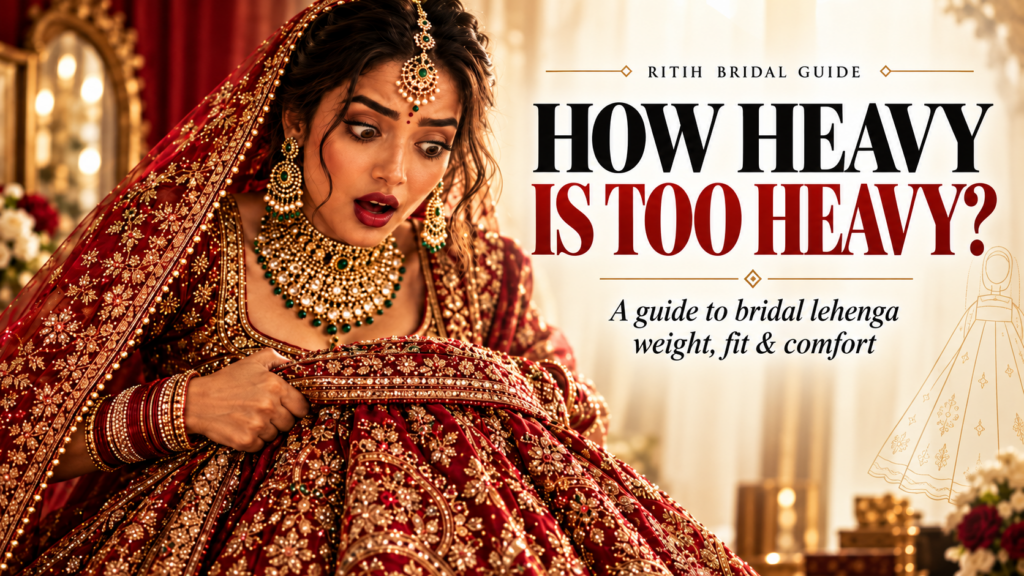
You can spend weeks thinking about the colour of your bridal lehenga.
Then the fabric. The embroidery. The blouse neckline. The dupatta. How much flare you want. Whether the border should be heavier. Whether the red is too red.
And never once ask:
How much is this lehenga actually going to weigh?
Then the finished outfit arrives.
Suddenly, it isn’t just about how beautiful it looks in front of a mirror. You start thinking about walking in it. Sitting through your ceremony. Getting up again. Taking photographs. Greeting people. Climbing stairs. Perhaps dancing several hours later.
That is usually when weight stops being an abstract number and becomes very real.
A bridal lehenga does not have to be lightweight to be comfortable. And a heavy lehenga is not automatically badly designed.
But I do think its weight should be something you understand before the outfit is finished, rather than a surprise you discover shortly before your wedding.
So, how heavy should a bridal lehenga actually be?
The slightly frustrating answer is that there isn’t one ideal number.
But there is a much better way to judge it.
Quick answer: There is no single ideal weight for a bridal lehenga. A heavier lehenga can sometimes be easier to wear than a lighter one if its weight is well distributed and it fits properly. What matters most is the combination of weight, fit, construction and movement — and whether the outfit suits what you will actually be doing on your wedding day.
There is no perfect weight for a bridal lehenga
It would be wonderfully simple if I could say:
A bridal lehenga should weigh exactly X kilograms.
But bridalwear doesn’t work like that.
Two lehengas weighing exactly the same can feel completely different once you put them on.
One may sit securely around your waist, distribute its weight well and move naturally with you.
Another may be lighter on the scales but constantly slip down, pull from one side, restrict your movement or make you feel as though you’re carrying the outfit rather than wearing it.
Your wedding plans matter too.
A lehenga you are perfectly happy wearing for a relatively calm ceremony may not be the outfit you’d choose for a sangeet where you’re planning to dance for an hour.
So instead of asking:
“What is the maximum weight a bridal lehenga should be?”
I would ask:
“Is this weight right for me, this outfit and the way I am actually going to wear it?”
That question is much more useful.
First, let’s clear up one misconception: heavy does not mean luxurious
There can be an unspoken assumption around bridalwear that more is automatically better.
More embroidery.
More stones.
More fabric.
More layers.
More weight.
But the number on the scales tells you remarkably little about how luxurious a lehenga actually looks.
Beautiful bridalwear can get its richness from the quality of the embroidery, the placement of the motifs, the fabric, the cut, the proportions, the border, the blouse, the colour and the way all of those elements work together.
A lehenga does not need every inch of its surface covered to have impact.
Sometimes carefully placed embroidery creates far more visual drama than uniformly heavy embellishment.
And that matters because it gives you choices.
If you love a richly worked blouse, perhaps the skirt doesn’t need the same embroidery density everywhere.
If you want a very generous flare, you might balance that with a lighter base fabric.
If you’ve fallen in love with a dramatic second dupatta, perhaps both dupattas don’t also need extremely heavy borders.
Designing for comfort doesn’t mean removing the bridal detail. It means deciding where that detail matters most.
That is a very different thing.
So what actually makes a bridal lehenga heavy?
Usually, it isn’t one single feature.
The final weight is the result of lots of individual design decisions adding up.
And some of those decisions are easy to overlook when you’re choosing an outfit from photographs.
The base fabric
Your lehenga already has a weight before the first bead or stitch of embroidery is added.
Velvet, heavier silks and densely woven fabrics can naturally have more substance than lighter fabrics such as georgette, chiffon or some nets.
But don’t assume a light base fabric automatically means a lightweight finished lehenga.
Cover enough of it with dense stones, beads or metallic embroidery and the finished garment can still become very heavy.
The fabric is simply the starting point.
If you’re still deciding between fabrics, I’ve also written a guide to choosing the right fabric for your bridal lehenga, including how season and climate can affect your choice.
The embroidery and embellishment
This is often where the kilos begin to creep up.
Zardozi, dabka, stones, crystals, pearls, beads, sequins and metallic elements might not feel particularly heavy when you look at one small embroidery sample.
If some of those terms are unfamiliar, my bridal lehenga glossary explains common fabrics, embellishments, silhouettes and weddingwear terminology in plain English.
But bridal skirts contain a lot of fabric.
Repeat that work across several metres and suddenly those little additions become significant.
The density matters too.
An outfit with embroidery concentrated around a border and selected motifs can feel very different from one where heavy embellishment covers almost the entire skirt.
This is why two lehengas that look similarly ornate in photographs can feel completely different once worn.
The amount of fabric and flare
That beautiful sweeping ghera has to come from somewhere.
More panels or kalis generally mean more fabric.
More fabric can mean more weight.
And if those additional panels are also heavily embroidered, you are multiplying both at the same time.
Again, this doesn’t mean you should avoid flare.
A generous skirt can be one of the most beautiful parts of a bridal lehenga.
It simply means that flare and embroidery should be considered together, rather than as two completely separate decisions.
Lining and internal construction
The parts you don’t really see matter too.
Lining gives the garment finish, structure and comfort against your skin.
Internal layers help create and support the silhouette.
A well-constructed lehenga needs these elements, but they all contribute something to the final weight.
This is also where construction becomes more important than simply asking for the lightest possible garment.
Removing useful structure purely to save a small amount of weight can create a different problem altogether.
Cancan
Cancan helps give many bridal lehengas their volume and dramatic shape.
But more cancan isn’t automatically better.
The number of layers, their stiffness and where they’re positioned can affect how easily you walk, sit and move.
And there is another important point.
If your finished lehenga feels extremely heavy, removing the cancan does not necessarily solve the problem.
If most of the weight is coming from dense embroidery, stones or a heavy outer fabric, reducing the cancan may change the silhouette far more than it changes the overall weight.
That is why cancan needs to be considered as part of the complete construction rather than treated as an emergency on/off switch.
Borders, trains and hems
A heavily embellished border can be surprisingly substantial because it runs all the way around a large skirt.
Add a longer train and you have more fabric and potentially more embroidered surface area again.
It’s easy to concentrate on the centre of the lehenga when looking at photographs, but a lot can be happening around the hem.
Your blouse
We tend to talk about “lehenga weight” as though we’re only talking about the skirt.
But your blouse matters too.
If it contains dense stonework, beadwork or metallic embroidery, that weight is being carried by your upper body.
And where that weight sits can make a considerable difference to how comfortable the complete outfit feels.
Your dupatta — or dupattas
The skirt isn’t the end of the story.
A heavily worked dupatta adds another layer of weight.
Two dupattas add more again.
And where you drape them matters.
One may be sitting on your head while another crosses your shoulder or body. If the borders are heavily embellished, that can become tiring in a completely different way from the weight of your skirt.
Which brings us to something I think is even more important than the number of kilograms.
Where the weight sits can matter as much as how much the outfit weighs
Imagine two lehengas.
The first is slightly heavier, but it sits securely around your waist and the weight is distributed evenly through the skirt.
The second is lighter, but the waistband keeps slipping and a heavily worked section constantly pulls down on one side.
Which one do you think you’ll notice more after four hours?
Probably the lighter one.
The same principle applies to the rest of your outfit.
A heavily worked dupatta pulling from one shoulder, or a blouse with a lot of embellishment concentrated in one area, can become tiring even when the complete outfit doesn’t sound extraordinarily heavy.
That is why I would never judge the comfort of a bridal lehenga from the number on a scale alone.
For me, the much more useful equation is:
Weight + fit + construction + movement.
Those four things together tell you far more than kilograms on their own.
A heavier lehenga that fits well can feel easier than a lighter one that doesn’t
Fit changes everything.
If your waistband doesn’t sit correctly, you may spend the entire day pulling your lehenga back into position.
If the skirt is too long, you’ll alter the way you walk.
If your blouse or dupatta is pulling awkwardly, your posture changes.
Little things become big things when you’re wearing an outfit for several hours.
This is one reason final fitting and adjustment are so important in bridalwear.
The aim isn’t simply to make the garment fit your measurements.
It needs to feel secure enough that you aren’t thinking about it constantly.
You can read more about that in my guide to how to ensure your bridal lehenga fits properly.
But there’s another part of this conversation that brides sometimes forget.
Your wedding isn’t a photoshoot.
Think about what you will actually be doing in the lehenga
Before deciding how much weight you are comfortable carrying, mentally walk through your wedding day.
Not the photographs.
The actual day.
Will you have a long bridal entrance?
Are there stairs at the venue?
Will you need to sit on the floor or move around the mandap?
Will you spend a long time standing for photographs?
Will you be walking outside?
Is the venue on grass or uneven ground?
Will you be dancing?
Are you going to wear this outfit for three hours?
Six?
Ten?
Will you change into something else later?
These questions can completely change the conversation.
A bride choosing a lehenga mainly for her ceremony may happily accept more weight because she loves the richness of the embroidery.
Another bride planning a very active sangeet might make different choices.
Neither is wrong.
If you have several wedding functions, it is particularly worth asking:
Which event involves the most movement?
The outfit you’re comfortable wearing while largely seated may not be the one you want when you’re expecting to dance.
And no, looking bridal doesn’t require carrying the maximum possible weight
This is one of the ideas I’d really like more brides to question.
Somewhere along the way, “bridal” can become associated with “more”.
More embellishment.
More fabric.
More jewellery.
More layers.
More everything.
But visual impact can come from much more than sheer weight.
It can come from proportion.
A beautifully balanced silhouette can look incredibly dramatic.
It can come from placement.
A concentrated embroidered border or motif can sometimes have more visual impact than uniform work everywhere.
It can come from fabric.
Texture, sheen and drape can make an outfit feel luxurious even before embroidery is added.
It can come from colour.
A beautifully judged colour combination can do an enormous amount of visual work.
It can come from the blouse.
Your blouse is visible in portraits and close-up photographs far more often than brides sometimes realise.
And it can come from how the complete outfit works together.
The skirt, blouse, dupatta, jewellery and styling are not separate design projects.
They are one look.
A bridal lehenga does not have to prove that it is bridal by being difficult to wear.
If you genuinely love a richly embellished, substantial lehenga and you’re comfortable wearing it, wonderful.
You don’t need to apologise for wanting drama either.
The point isn’t that lighter is always better.
The point is that you should understand the trade-off you’re making.
A good bridal design is often about trade-offs
This is where bespoke design becomes particularly interesting.
You don’t always have to choose between:
beautiful or comfortable.
Sometimes the solution is simply to decide where you want the drama.
Want a heavily embellished blouse?
Perhaps the skirt can have more breathing space.
Want a huge, flowing ghera?
Perhaps you choose a lighter base and use embroidery strategically.
Want an ornate double-dupatta look?
Perhaps one dupatta can carry more of the decorative work while the other remains easier to wear.
Love the richness of traditional embroidery?
The answer doesn’t have to be “use less of it everywhere”.
It can be:
Use it where it creates the most impact.
Thinking about the entire outfit rather than making every individual component as elaborate as possible can make an enormous difference.
This flexibility is one of the reasons I value a bespoke bridal lehenga process: the fabric, structure, embroidery and comfort can all be considered together rather than treated as fixed decisions.
If you’re ordering remotely, ask about weight before the outfit is finished
This deserves particular attention if you’re ordering your bridal lehenga from India while living overseas.
You may not have the opportunity to try your finished outfit halfway through production.
By the time it reaches you, major design decisions may already be difficult to change.
So ask the question early.
What is the approximate finished weight expected to be?
Then ask the important follow-up:
What exactly does that figure include?
Is it:
- the skirt only?
- skirt and blouse?
- skirt, blouse and dupatta?
- the complete double-dupatta set?
- cancan and lining too?
Without that context, comparing two quoted weights isn’t particularly useful.
I would also ask what’s contributing most to the expected weight.
Is it the fabric?
The embroidery?
The stones?
The number of panels?
The cancan?
A heavily embellished dupatta?
Once you understand why the garment will be heavy, you can actually discuss possible alternatives.
That conversation becomes much harder after everything has already been made.
Questions to ask before you approve your bridal lehenga
You don’t need to interrogate your designer with a spreadsheet.
But these are useful questions:
Approximately how heavy do you expect the finished outfit to be?
Does that weight refer to the skirt or the entire set?
Which parts of the design are contributing most to the weight?
Can the embroidery density be adjusted without losing the overall look?
Would another base fabric produce a similar effect with less weight?
How much cancan will be used?
Will the waistband comfortably support the skirt?
Is there anything you would change if comfort and movement were particularly important to me?
And perhaps the most useful:
“If I want this overall look but don’t want it unnecessarily heavy, what would you change?”
A good answer to that question tells you quite a lot.
Don’t wait until the wedding day to discover how your lehenga actually feels
Your finished lehenga arrives.
You open the box.
You put it on.
You look in the mirror.
You love it.
And then you take it off five minutes later because you don’t want to crease it.
That isn’t really a wear test.
Before the wedding, give yourself enough time to find out what the outfit feels like when you actually move in it.
Wear the footwear you plan to use.
Secure the lehenga properly.
Drape the dupatta as you expect to wear it.
Then spend some meaningful time in the complete outfit.
Give your lehenga a proper wear test
For a complete walkthrough of putting the outfit together and testing how it moves, see my guide to how to wear a bridal lehenga.
Try:
- walking around normally
- sitting down and standing back up
- taking full-sized steps
- walking up and down stairs if relevant
- turning
- raising your arms
- sitting for several minutes
- practising your bridal entrance
- trying some of your dance movements if you’re planning to dance
You aren’t trying to recreate the whole wedding in your living room.
You are looking for warning signs.
Is the skirt constantly slipping?
Is the waistband digging painfully?
Are you taking unnaturally small steps?
Is one dupatta pulling your head or shoulder backwards?
Do you already feel exhausted after ten minutes?
Those are things worth knowing while there is still time to do something about them.
Not on the morning of your wedding.
For the full wedding-day setup, see my guide to wearing and draping your bridal lehenga, including the blouse, skirt and dupatta.
What if your lehenga is already finished and feels too heavy?
Don’t panic — but don’t assume you simply have to endure it either.
The right solution depends on where the weight is actually coming from.
If excessive cancan is part of the problem, a bridal tailor may be able to reduce or alter the internal layers.
If the waistband isn’t supporting the skirt properly, a fitting adjustment may make the outfit feel far more secure.
If your dupatta arrangement is contributing to the discomfort, changing how it is draped or supported may help.
Sometimes the solution is not reducing the garment’s actual weight very much at all.
It is distributing that weight better.
That is another reason I would have an experienced bridal tailor look at the full outfit before making significant changes.
Removing layers, changing structure or cutting away elements can also change the silhouette and balance of the original design.
Can you just remove the cancan to make a heavy lehenga lighter?
Sometimes reducing the cancan helps.
But it isn’t a guaranteed fix.
If the main weight is coming from embroidery, stones or the outer fabric, removing several layers underneath may make less difference than you expect.
And it may dramatically change the way the skirt falls.
That beautiful volume you originally chose might disappear with it.
So I wouldn’t start with:
“How much cancan can I remove?”
I’d start with:
“Where is the weight actually coming from?”
Then make the decision.
What about a 7 kg bridal lehenga?
This is where brides understandably want a number.
A 7 kg outfit is a significant amount of clothing to wear.
For some brides and some occasions, it may be perfectly manageable.
For others — particularly if you’re dancing, walking a lot or wearing the outfit for many hours — it may feel very substantial.
But again, the number needs context.
Is 7 kg the skirt alone?
Or the full outfit?
How is the waistband constructed?
Where is the embroidery concentrated?
How much of that weight is in a dupatta you’re carrying on your head?
How long are you wearing it?
The answers can change the experience considerably.
What about a 10 kg bridal lehenga?
A 10 kg bridal outfit is undeniably substantial.
If you’re considering something in that region, I would pay particular attention to construction, fit, weight distribution and what you actually plan to do while wearing it.
And if you put the finished outfit on and find yourself exhausted or uncomfortable after only a few minutes, I wouldn’t dismiss that feeling because someone tells you:
“Bridal lehengas are supposed to be heavy.”
Your comfort is useful information.
Listen to it.
The conversation I think every bride should have before her outfit is made
When I’m thinking through a bespoke bridal lehenga, weight shouldn’t be discussed in isolation.
I want to understand the whole picture.
Which event is this outfit for?
How many hours are you likely to wear it?
Will you dance?
What sort of venue are you getting married in?
Do you want a dramatic flare?
Which fabrics are you drawn to?
How densely embellished do you want the outfit to feel?
Have you worn heavier Indian outfits before?
Is staying relatively lightweight especially important to you?
Those answers influence the design.
Sometimes a bride will decide:
I know this will be quite heavy, but I love it and I’m happy with that.
That’s completely valid.
Another bride may say:
I want the same sense of occasion, but I need to move comfortably all evening.
Also completely valid.
The important thing is that the outcome is a choice, not a surprise.
Your bridal lehenga weight checklist
Before you finalise your outfit, make sure you have thought about:
- the approximate finished weight
- whether that figure is for the skirt or complete outfit
- which materials are contributing most of the weight
- the density and placement of embroidery
- the amount of fabric and flare
- the cancan and internal structure
- the blouse weight
- your dupatta or double-dupatta arrangement
- how securely the skirt will sit at your waist
- how many hours you expect to wear it
- how much walking, sitting or dancing you will do
- whether you have enough time after delivery for final adjustments
And then there is one final question.
Perhaps the question isn’t simply:
“How heavy should my bridal lehenga be?”
Perhaps it’s:
“How much weight is right for me, for this outfit and for the wedding day I am actually going to have?”
And once the finished lehenga arrives, there is an even simpler test.
Can I comfortably be a bride in this outfit — rather than simply stand still in it?
That is the number that really matters.
FAQs
Is 7 kg heavy for a bridal lehenga?
A 7 kg bridal lehenga or outfit will feel substantial to many brides, particularly if you plan to dance or wear it for several hours. However, total weight alone doesn’t determine comfort. Fit, waistband support, construction, weight distribution and what is included in the quoted 7 kg all matter.
Ask whether the figure refers to the skirt alone or the complete outfit including the blouse and dupatta.
Is a 10 kg bridal lehenga too heavy?
A 10 kg bridal outfit is very substantial, although there is no universal maximum weight that applies to every bride.
If you are considering an outfit around this weight, pay particular attention to how the skirt is supported, where the embellishment sits, how long you will wear it and how much movement your wedding involves.
If you already have the outfit and find it uncomfortable within a short period, have a bridal tailor assess the fit and construction rather than assuming discomfort is simply something you need to accept.
What is a normal weight for a bridal lehenga?
There isn’t a recognised industry standard defining a “normal” bridal lehenga weight.
The finished weight varies considerably according to fabric, embroidery, embellishment, number of panels, lining, cancan, blouse and dupatta.
Rather than relying on a generic weight chart, ask for the approximate weight of the specific outfit you are considering and clarify exactly what that figure includes.
Does cancan make a lehenga heavy?
Cancan adds some weight, but it may not be the main source of heaviness.
Dense embroidery, stones, beads, heavier fabrics, multiple layers and embellished dupattas can all contribute significantly.
Reducing cancan may make an outfit easier to move in, but it can also change the silhouette, so it is best considered as part of the complete construction.
How can I make a bridal lehenga lighter?
If your lehenga is still at the design stage, you have the most options.
You may be able to use a lighter base fabric, reduce embroidery density in selected areas, choose lighter embellishment materials, concentrate work where it has the most visual impact, adjust the amount of cancan or reconsider the weight of the dupatta.
Once the garment has been completed, options become more limited, which is why discussing weight early is worthwhile.
Should I ask the weight before ordering a bridal lehenga online?
Yes.
Ask for the approximate finished weight and clarify whether it refers to the skirt or the complete outfit.
If you’re ordering remotely, also ask which elements contribute most to the weight and whether there is scope to make the design lighter if comfort is important to you.
Is a lighter bridal lehenga less luxurious?
Not necessarily.
Luxury can come from the quality of the fabric, craftsmanship, embroidery, fit, construction and overall design rather than simply the amount of material or embellishment used.
A thoughtfully designed lighter lehenga can look every bit as special as a much heavier outfit.