
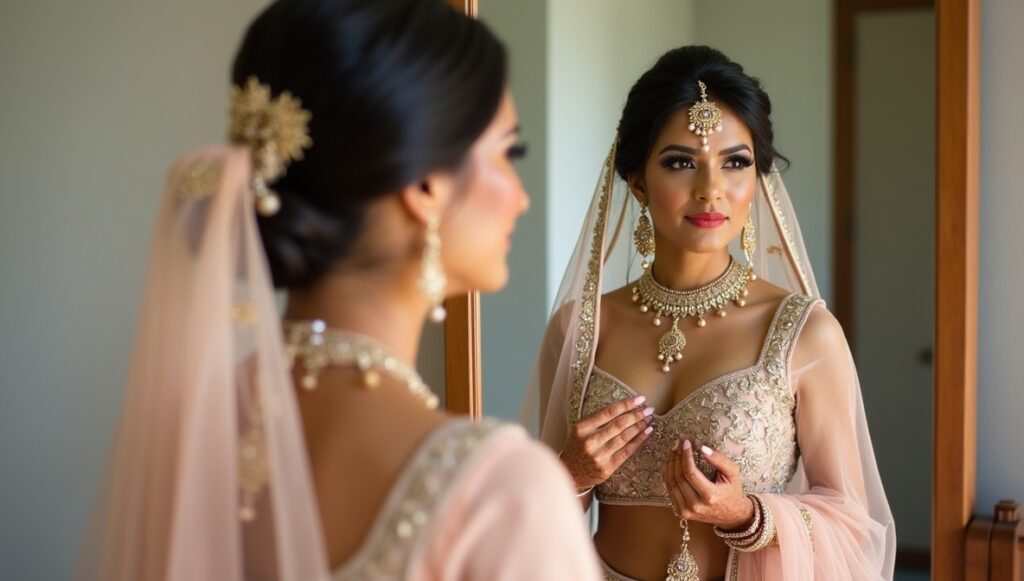
You can put on a bridal lehenga, stand in front of the mirror and think everything looks perfect.
Then you start walking.
The skirt shifts. The waistband takes the weight. The cancan moves differently. Your dupatta starts pulling from one side. You sit down, stand back up, raise your arms, take a few steps — and suddenly the outfit feels completely different from the one you were admiring thirty seconds earlier.
That is why wearing a bridal lehenga properly is about much more than knowing which piece goes on first.
Your outfit needs to work when you move, not only when you stand still.
And when you’re wearing several layers of fabric, embroidery, jewellery and perhaps more than one dupatta for several hours, a little preparation can make a very big difference.
Quick answer: how do you wear a bridal lehenga properly?
Wear your lehenga at the waist position it was fitted for and fasten it securely without over-tightening it. Check the length with the actual shoes you plan to wear, arrange the cancan and skirt evenly, and make sure your dupatta is anchored without pulling on your head or shoulders.
Then test the complete outfit while walking, sitting, standing, turning and raising your arms.
The most important thing is not simply whether the lehenga looks right.
It is whether the combination of fit, weight, construction and movement still works once your wedding day starts moving.
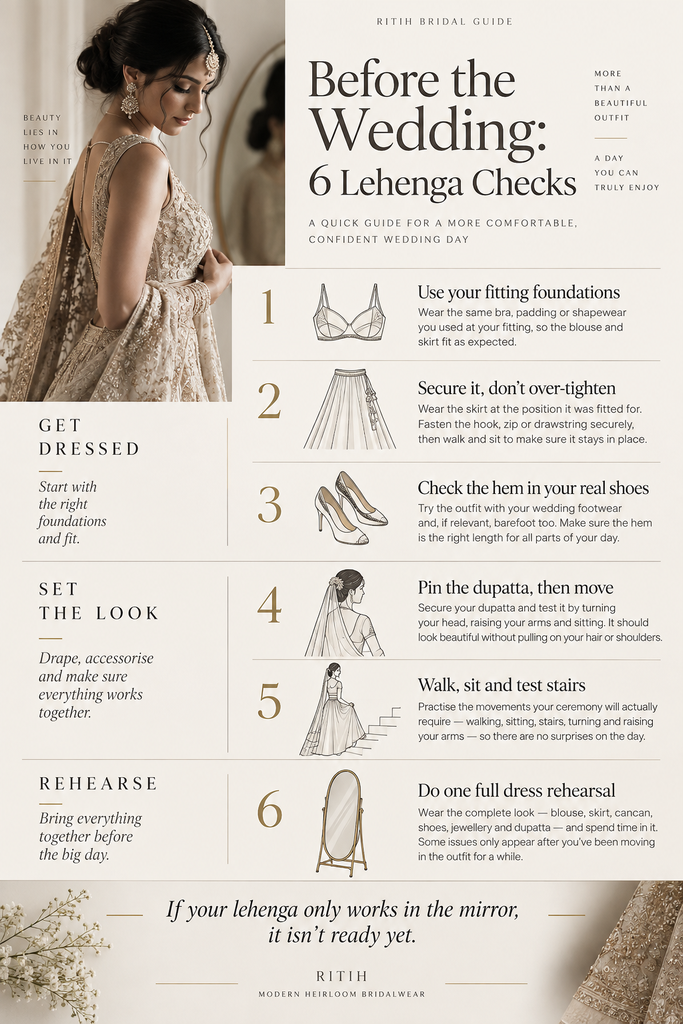
Before you put anything on, get everything ready
This sounds obvious.
On a wedding morning, it often isn’t.
Your outfit may include:
- blouse
- lehenga skirt
- cancan or underskirt
- one or two dupattas
- jewellery
- maang tikka
- waist belt
- footwear
- blouse cups or bra
- shapewear, if you use it
- safety pins
- fashion tape
- latkans or detachable details
It is much easier to dress calmly when everything is laid out and checked beforehand.
If possible, don’t leave your first full outfit assembly until the wedding morning.
You should already know which hooks close where, which dupatta goes on your head, which shoes work with the hem and who is going to help you.
We will come back to the full dress rehearsal later, because I think it is one of the most useful things a bride can do.
But first, let’s actually get dressed.
Step 1: Start with the foundations you used at your fitting
The clothes underneath your bridal lehenga can affect how the complete outfit fits.
If you wore a particular bra, blouse padding or shapewear at your fitting, try to use the same thing on the wedding day.
Changing to something very different can alter:
- blouse fit
- bust position
- waist measurement
- how the skirt sits
- how comfortable you feel
This doesn’t mean you need complicated bridal shapewear.
It simply means that the foundation underneath the outfit should be something you already know works.
Comfort matters here too.
If something feels uncomfortable before you have even put the lehenga on, adding embroidery, jewellery and several hours of wear isn’t likely to improve it.
Step 2: Put on the blouse and test it before adding anything else
Once your blouse is on, don’t immediately move to the next step.
Take a minute to check it properly.
Ask yourself:
- Does it sit correctly at the bust?
- Are the shoulders lying flat?
- Is anything digging into your underarms?
- Does the back fastening feel secure?
- Can you breathe comfortably?
- Can you lift your arms?
- Can you reach forward?
- Does the blouse ride up when you move?
A blouse can look beautiful when your arms are resting at your sides and become restrictive as soon as you raise them.
That matters when you’re putting on a garland, hugging relatives, dancing or even adjusting your dupatta.
Your wedding outfit needs to accommodate real movement, not mannequin posture.
Step 3: Put the lehenga on at the waist position it was designed for
There isn’t one universal point where every lehenga should sit.
Some are designed to sit at the natural waist. Others are worn slightly differently depending on the blouse proportions, body shape and intended silhouette.
The important thing is:
Wear it where it was fitted to sit.
Once it is in position, fasten the hook, zip, drawstring or other closure properly.
The aim is secure, not painfully tight.
Pulling a drawstring as tightly as possible is not a substitute for correct fitting.
A skirt that is too tight can dig in when you sit and become uncomfortable over several hours.
A skirt that is too loose may gradually slip lower as you walk.
And that last point is important.
Don’t test the waist only while standing still
Once the lehenga is fastened, walk around for several minutes.
Then sit down.
Stand up again.
Turn.
Walk some more.
If the skirt gradually drops, twists or starts needing repeated adjustment, don’t simply tell yourself you’ll manage on the wedding day.
That is exactly the kind of problem you want to discover while there is still time to correct it.
For a deeper guide to measurements, waist position and overall fitting, see my guide to how to ensure your bridal lehenga fits properly.
Step 4: Arrange the cancan and skirt before judging the silhouette
If your lehenga contains cancan or internal layers, they may need a little arranging once the skirt is on.
Don’t judge the shape immediately after pulling the lehenga over your body.
Let the layers settle.
Gently distribute the volume around you so the skirt isn’t bunched heavily in one area and flat in another.
Then walk a little and see how it behaves.
Cancan isn’t just about making the lehenga look bigger in photographs.
It affects:
- how the skirt moves
- how easily you sit
- how much space the outfit occupies
- how it behaves on stairs
- how the hem falls around your feet
More cancan is not automatically better.
The right amount is the amount that gives you the silhouette you want without making the outfit unnecessarily difficult to manage.
If you are still deciding how much structure, embroidery or overall garment weight you are comfortable with, read my guide to how heavy a bridal lehenga should be.
That article goes into the relationship between weight, embroidery, fabric, cancan and movement in much more detail.
Step 5: Put your actual wedding shoes on before checking the length
This is one of those details that seems small until it isn’t.
Heel height changes where your lehenga hem sits.
A skirt that is perfect with a three-inch heel may suddenly drag when you change into flats.
And if your ceremony involves removing your shoes, think about that too.
You may spend part of the day wearing heels and another part barefoot or in lower footwear.
So before the wedding, test the lehenga with:
- your main wedding shoes
- any planned backup footwear
- bare feet, if relevant to your ceremony
Then walk.
Don’t only look at the hem in the mirror.
Check whether your foot catches underneath it.
Check whether the front is too long.
Check whether a train is dragging in a way that will need help.
A beautiful hem is only useful if you can get from one end of the venue to the other without fighting it.
Step 6: Check how the skirt behaves when you walk
Most brides do not need to learn some special “bridal walk”.
But you may need to get used to the amount of fabric around your legs.
Take normal, controlled steps.
Pay attention to where the front hem sits.
Try turning.
Try walking more slowly and then at your normal pace.
If the lehenga has a lot of flare, you may find that giving it a little space to settle as you turn feels more natural than trying to force the skirt to move instantly with you.
The goal isn’t to perform.
It is simply to stop the outfit from surprising you on the day.
And whatever you do, don’t spend the entire wedding repeatedly kicking the skirt forward because the hem was never adjusted correctly.
If that is necessary during your rehearsal, the problem is worth fixing.
Step 7: Add jewellery with movement in mind, not just appearance
Jewellery changes the way the whole outfit behaves too.
Instead of simply asking:
“Does this necklace look good with my blouse?”
also check:
- Does it interfere with the blouse neckline?
- Does it get trapped under the dupatta?
- Does your maang tikka compete with where the head dupatta needs to be pinned?
- Are bangles catching on delicate embroidery?
- Are earrings getting caught in the dupatta border?
- Is a waist belt affecting the skirt fastening?
These little interactions are exactly what a full rehearsal reveals.
A necklace that looks perfect in a photograph is less useful if it spends the ceremony tangled in your dupatta.
Step 8: Decide how your dupatta needs to work before deciding how it looks
There are dozens of ways to drape a lehenga dupatta.
You don’t need all of them.
You need the one that works for your outfit, your ceremony and the amount of movement you expect.
A single shoulder drape
This can be relatively easy to manage and keeps much of the blouse visible.
It may work well when you expect to move around more freely.
A head dupatta
A veil over the head can create a very traditional bridal look.
But the weight of the border and embroidery matters.
Think about where the dupatta will be anchored and whether it pulls on your hair, scalp or jewellery.
A beautiful head drape should not require you to spend the ceremony feeling as though your hair is being pulled backwards.
A double-dupatta look
If you’re wearing two dupattas, they don’t have to perform exactly the same job.
One can be lighter and easier to secure on the head while the other provides more decorative weight across the body.
That can sometimes be much more manageable than putting the heaviest piece on your head simply because it contains the most embroidery.
Cross-body or more securely pinned drapes
For a function where you expect to move more, a securely anchored drape may feel easier than a very loose arrangement requiring constant adjustment.
The point isn’t that one style is universally better.
It is that:
The prettiest drape in a photograph isn’t necessarily the best drape for eight hours of walking, hugging, sitting and raising your arms.
Step 9: Secure the dupatta — but don’t turn it into armour
Pins are useful.
Too many badly placed pins can create another problem.
Your dupatta should feel secure enough that you aren’t thinking about it every few minutes.
But you should still be able to move.
Once it is pinned:
- turn your head
- raise your arms
- sit down
- stand up
- bend slightly forward
- walk across the room
Watch for pulling.
If raising your arms causes the dupatta to tug sharply at your shoulder or head, the pinning arrangement needs another look.
A few minutes of testing now can save hours of irritation later.
If some of the terms used in bridalwear — such as cancan, ghera, zardozi or different garment elements — are unfamiliar, my bridal lehenga glossary explains common terms in plain English.
Then comes the part many “how to wear a lehenga” guides forget
At this point, you are dressed.
But your wedding hasn’t started yet.
This is where the important testing begins.
Because your lehenga is not going to spend the wedding standing still in front of a mirror.
You are going to live in it.
How to walk in a bridal lehenga without constantly thinking about it
Start by walking around somewhere safe before the wedding.
Not five steps.
Actually spend a little time in the outfit.
You want to notice:
- whether the waistband moves
- whether the hem catches
- whether the cancan feels restrictive
- whether your dupatta shifts
- whether jewellery catches
- whether your stride becomes unnaturally short
If the outfit forces you to move awkwardly, ask why.
Sometimes the solution is a small alteration.
Sometimes it is adjusting the drape.
Sometimes it is changing footwear.
Sometimes it is simply becoming familiar with how the skirt moves.
The aim is for the outfit to become something you stop thinking about.
How to manage stairs in a bridal lehenga
Stairs deserve rehearsal.
Especially if you have:
- a long skirt
- heavy cancan
- a train
- both hands occupied
- multiple dupattas
Use a handrail if one is available.
If you need to lift the front of the skirt slightly, practise doing it neatly rather than discovering the technique in front of your entire wedding party.
If the outfit has a train or a lot of fabric at the back, having one trusted person help can make things much easier.
There is no prize for attempting every staircase unaided.
How to sit comfortably in a bridal lehenga
Sitting can completely change how a lehenga feels.
The waistband may suddenly feel tighter.
Cancan can push forward.
The blouse can shift.
The dupatta may begin pulling.
So don’t simply sit for two seconds during your rehearsal.
Sit for a little while.
Try a normal chair.
If your wedding ceremony uses lower seating, test something reasonably similar beforehand if you can.
Ask yourself:
- Is the waist digging in?
- Can the skirt spread naturally?
- Does the cancan bunch awkwardly?
- Is the blouse riding up?
- Does the dupatta pull when you lean forward?
- Can you stand up again without stepping on the skirt?
These things are much easier to solve before the day.
Test the movements your actual ceremony requires
A general walk around your bedroom is useful.
Rehearsing the movements you will actually perform is better.
Raise your arms as you might for the jaimala.
Bend gently as you might when receiving blessings.
Turn while wearing the full dupatta arrangement.
If you will be doing pheras, walk a small circle.
If you know you will sit cross-legged or on lower seating, test that too.
If you’re dancing, try some of your actual movements.
You may discover that a blouse looks perfectly fitted but restricts one particular arm movement.
Or that a dupatta stays beautifully in place until you lift both hands.
These are exactly the discoveries you want to make before the wedding.
How to dance in a bridal lehenga
You don’t need to perform an entire sangeet routine during your dress rehearsal.
But if you know you’ll dance, test your range of movement.
Can you:
- raise your arms comfortably?
- turn without stepping into the hem?
- take wider steps?
- move without the skirt slipping?
- keep the dupatta secure?
- bend slightly without the blouse or waistband becoming restrictive?
A very substantial lehenga may be perfectly comfortable for your ceremony and much less suitable for energetic dancing.
That doesn’t make it a bad lehenga.
It simply means that what you are doing in the outfit matters.
That is also why I don’t believe bridalwear should be judged from weight alone.
Weight + fit + construction + movement are all connected.
Yes, work out how you are going to use the bathroom too
This may be the least glamorous section of the article.
It may also be one of the most useful.
If you’re wearing several metres of fabric, embroidery and layers of cancan for many hours, there is a reasonable chance you’ll need the bathroom.
Before the wedding, find out how much of the skirt you can comfortably gather yourself.
If the outfit is extremely voluminous, decide whether you will need help.
And if you do, choose someone you are actually comfortable asking.
It is much easier to have one mildly awkward conversation beforehand than to invent a solution while wearing a full bridal outfit.
Your lehenga does not become less beautiful because you planned for normal human biology.
Don’t make your wedding morning the first time everything meets
This is one of the biggest pieces of advice I would give any bride.
Have a full dress rehearsal.
Not only a fitting.
The complete outfit.
Wear:
- the underwear or shapewear you plan to use
- blouse
- skirt
- cancan
- wedding footwear
- jewellery
- maang tikka or head jewellery
- waist belt if applicable
- every dupatta
- the actual pinning arrangement
Then spend some time in it.
Walk.
Sit.
Stand.
Use stairs if relevant.
Raise your arms.
Turn.
Bend gently.
Try your ceremony movements.
Try a little dancing if you expect to dance.
And don’t take everything off after ninety seconds just because it looks right.
Some problems only reveal themselves after the outfit has been moving for a while.
A skirt that appears perfectly secure at first may gradually begin slipping.
A dupatta that feels fine for two minutes may become uncomfortable after twenty.
That is exactly why you rehearse.
Choose one person who knows how your outfit works
Your wedding morning isn’t the ideal time for five people to discover that nobody knows where your second dupatta is supposed to be pinned.
Choose one trusted person.
It could be your sister, friend, mum, stylist or someone else you’re comfortable with.
Let that person see the full dress rehearsal.
Show them:
- how the skirt fastens
- where the dupatta is pinned
- which side the train should fall
- whether a pin needs replacing after the ceremony
- where your emergency kit is
- how the outfit should look when everything is sitting correctly
That person doesn’t need to become your full-time bridal dresser.
They simply need to know enough that if something shifts, you are not trying to explain your outfit from scratch.
Put together a small lehenga emergency kit
You probably don’t need an enormous bridal survival box.
A small outfit-specific kit is enough.
Consider:
- small safety pins
- larger safety pins
- matching needle and thread
- spare hook and eye if relevant
- skin-safe fashion tape if you know you need it
- tissues or a clean cloth
- small stain-removal item appropriate for the fabric
- spare fastening supplied with the garment, if applicable
And then give the kit to someone else.
A beautifully prepared emergency kit is not very useful if it is sitting somewhere inaccessible while you are wearing several layers of embroidered clothing.
Warning signs I would not ignore
Your bridal lehenga does not need to feel like loungewear.
It is formal clothing.
It may be structured.
It may be substantial.
But there is a difference between noticing you’re wearing a bridal outfit and actively fighting it.
Pay attention if:
- the skirt keeps slipping
- the waist is painfully tight
- the hem repeatedly catches your foot
- the blouse prevents normal arm movement
- the dupatta constantly pulls your head or shoulder
- cancan makes sitting extremely difficult
- pins are digging into you
- you are exhausted after only a very short wear test
- you cannot comfortably perform movements your ceremony requires
Don’t dismiss these things simply because someone says:
“Bridal lehengas are supposed to be uncomfortable.”
They don’t have to be effortless.
But they do need to be wearable.
Wearing a lehenga properly is really about confidence through familiarity
There is something reassuring about having already worn the complete outfit once.
You know where the skirt sits.
You know what the cancan does when you sit.
You know where the dupatta pulls.
You know how high you can comfortably raise your arms.
You know whether you need help on stairs.
And because those questions have already been answered, you are much less likely to spend your wedding thinking about your clothes.
That is the goal.
Your bridal lehenga deserves attention while you’re preparing for the wedding.
You shouldn’t have to spend the wedding giving it attention every five minutes.
Wedding-morning bridal lehenga checklist
Before you leave to start your wedding day, check:
- blouse fit feels secure and comfortable
- skirt is sitting at the position it was fitted for
- waistband is secure without digging in
- drawstring, zip or hooks are correctly fastened
- cancan and skirt volume are evenly arranged
- hem works with your chosen shoes
- you can walk without catching the skirt
- jewellery isn’t snagging the fabric
- dupatta is securely anchored
- head drape isn’t pulling uncomfortably
- you can raise both arms
- you can sit and stand comfortably
- your helper knows how the outfit is arranged
- emergency pins and repair items are with someone you trust
And then stop adjusting everything.
At some point, the preparation is finished.
Go and enjoy your wedding.
Because the best sign that your bridal lehenga is working isn’t that everyone can see how beautifully it has been arranged.
It is that you stop thinking about how you’re wearing it at all.
FAQs
How do you wear a bridal lehenga step by step?
Start with the same undergarments or foundation garments you used at your fitting, then put on and check the blouse.
Wear the lehenga skirt at the position it was fitted for and fasten it securely without over-tightening it. Arrange the cancan and skirt volume, put on your wedding shoes to check the hem, add jewellery and then secure the dupatta.
Once the full outfit is on, test it while walking, sitting, turning and raising your arms.
Where should a bridal lehenga sit on the waist?
A bridal lehenga should sit at the waist position it was designed and fitted for.
There is no single correct position for every bride or every lehenga because blouse proportions, body shape and garment design vary.
The important thing is that the skirt feels secure, supports its weight properly and does not gradually slip as you move.
How do I stop a heavy lehenga from slipping down?
First check whether the lehenga actually fits correctly rather than simply tightening the drawstring further.
The skirt should be supported securely at the waist, and its hook, zip or drawstring should be working properly.
Wear the lehenga for a while and walk around before the wedding. If it gradually slips lower, ask an experienced bridal tailor to assess the fit and weight distribution.
You can also read my guide to how heavy a bridal lehenga should be for more about weight, construction and comfort.
Should I wear my wedding shoes when fitting my lehenga?
Yes, ideally.
Your footwear affects where the hem falls, so it is useful to wear the actual wedding shoes or at least shoes with the same heel height during final fitting and dress rehearsal.
If you expect to remove your shoes during part of the ceremony, test the lehenga without them too.
How do you walk in a bridal lehenga without tripping?
Make sure the lehenga length is correct for your footwear first.
Practise walking in the complete outfit before the wedding so you understand how the skirt and cancan move around your legs.
If you constantly need to kick the front of the skirt out of your way, the hem or structure may need adjusting.
How do you sit comfortably in a lehenga with cancan?
Sit slowly and allow the skirt and cancan to spread around you rather than becoming heavily bunched in one place.
During your rehearsal, check whether the waistband digs in, the blouse rides up or the cancan pushes awkwardly forward.
If your ceremony uses low seating, practise sitting at a similar height before the wedding.
How do you secure a heavy bridal dupatta?
A heavy dupatta should be anchored securely without concentrating all of its weight at one uncomfortable point.
Where it is pinned depends on the drape, hairstyle and outfit construction.
After pinning, test the dupatta by turning your head, raising your arms, walking and sitting to make sure it doesn’t pull excessively on your hair, scalp or shoulder.
Is a lighter dupatta better for the head?
It can be.
Some brides prefer to use a lighter dupatta as the head veil and keep the more heavily embellished dupatta across the body, particularly with a double-dupatta look.
However, the best arrangement depends on your outfit, hairstyle, ceremony and the weight of each dupatta.
How do you manage stairs in a bridal lehenga?
Practise before the wedding if your venue has stairs.
Use the handrail where possible and lift the front of the skirt slightly if necessary so your feet have enough clearance.
A trusted helper can also manage a long train or excess fabric behind you.
When should I do a full bridal lehenga dress rehearsal?
Ideally, do it early enough that there is still time to make small adjustments before the wedding.
Wear the complete look rather than only trying the individual garments: blouse, skirt, cancan, shoes, jewellery and dupatta.
Spend enough time moving in the outfit for problems such as slipping, pulling or restrictive movement to become apparent.